The stretch between Luther and Roscoe reads like one continuous corridor on a map, and the listings along it read that way too: Beartooth views, cottonwoods and aspens, "power nearby," "good wells in the area." Prices per acre in this pocket sit meaningfully below Red Lodge proper and meaningfully above the county's remote-parcel floor. Most buyers assume the spread is measuring scenery or drive time. It is not. It is mostly measuring one regulatory line and one utility distance.
If you learn to read those two variables, the corridor stops looking like a single market and starts sorting itself into two very different transactions.
The line that splits the corridor in two
Carbon County's Environmental Health rules draw a bright line at twenty acres. On a parcel of less than twenty acres, not counting county road frontage, you cannot apply for a county septic permit until Montana DEQ issues a Certificate of Subdivision Approval, known as a COSA, which designates the approved water and wastewater facilities for the site. The DEQ review "is a time intensive process (currently around 6-8 months if no hurdles)," per Carbon County Environmental Health. On a parcel above twenty acres, DEQ is out of the picture entirely and only a county-level Construction Authorization is needed.
For a buyer, that single threshold can be worth six to twelve months of carrying cost. It is also why an 18-acre listing at $12,000 an acre and a 22-acre listing at $12,500 an acre are not really comparable properties. They are on opposite sides of a permit wall.
Two practical consequences follow. First, if a smaller parcel already has an approved DEQ COSA on file, that document is a real asset and worth confirming through the county before you write an offer. Second, if you are shopping the corridor without a hard build deadline, moving your search band from 17 to 25 acres up to 20 to 30 acres changes what your money buys in ways the list price will never signal.
The permit stack most buyers underestimate
Even on parcels above twenty acres, the septic permit is the last card in a sequence, not the first. Before Carbon County will process a septic Construction Authorization, you need to hold, in order:
- A Carbon County Development Permit from the Planning Department
- A Road Approach Permit from the Carbon County Road Department
- A Rural Address Assignment from Carbon County Disaster and Emergency Services
- A Floodplain Permit from the Carbon County Floodplain Administrator, if the site touches mapped floodplain
- Approval from the state (Montana DEQ for under-20-acre parcels, county sanitarian for 20-plus)
Every one of those items is straightforward on its own. Stacked together on a rural parcel with no address yet assigned and a road approach that needs cutting, they add months. Buyers who assume "we'll figure it out after closing" are the buyers whose first Montana winter arrives before their drainfield does.
The Carbon County Environmental Health office at 17 W 11th Street in Red Lodge is the counter you want to visit, ideally before offers rather than after. Their public guidance walks through the full sequence.
Reading "power nearby" and "good wells in the area"
Listing language along the corridor tends to describe utilities in reassuring, unspecific phrases. A 14-acre Luther-area tract on Barlow Creek advertises "power nearby, good wells in the area." A 19-acre parcel south of Red Lodge notes electric available "at the SW corner." Those descriptions are not the same product.
Three concrete questions convert the language into cost:
How far is the nearest transformer, in feet, from your intended build site? NorthWestern Energy will quote a service extension, and the number varies from a few hundred dollars to tens of thousands depending on distance, terrain, and whether you need to trench under a road. A parcel with power "at the corner" and a parcel with power "700 feet away" are different transactions even when the maps look identical.
Where will the well and drainfield actually sit relative to each other and to your neighbor's fence line? Under Montana rule ARM 17.36.323, an individual well must sit at least 50 feet from a septic tank and at least 100 feet from a drainfield, and a shared or public-water well jumps to 100 feet from the tank. On narrower parcels or long, thin cuts along the road, that geometry can eliminate otherwise attractive build sites before a shovel goes in the ground.
Does the parcel have an existing well log filed with DNRC, and does it also have a filed water right? A well log is not a water right. Buyers regularly conflate the two. As of January 1, 2026, new exempt wells also require a Notice of Intent filed with DNRC before the water is put to use, which is a paperwork step that did not exist in prior transactions and is easy to miss.
A conventional septic install in Montana typically runs from roughly $8,000 to $25,000 depending on site conditions, soil, and access, per the Montana Plumbing Authority. Add power extension, driveway approach, well drilling, and address assignment, and the pre-build spend on a raw Luther-corridor parcel commonly reaches six figures before any framing is done.
What the price-per-acre spread is actually measuring
Here is the shape of the corridor, using recent listing aggregate data:
| Reference market | Approx. price per acre | What that number is really pricing |
|---|---|---|
| Carbon County median (large-parcel aggregate) | ~$12,029 | Remote, often power-distant, 20+ ac |
| Carbon County average (all sizes) | ~$16,885 | Blended, weighted toward big holdings |
| Red Lodge listings average (Land.com) | ~$109,495 | Paved access, in-town or near-in |
| Willow Creek 3-ac tract, July 2026 | ~$150,000 | Small, view lot, near-in |
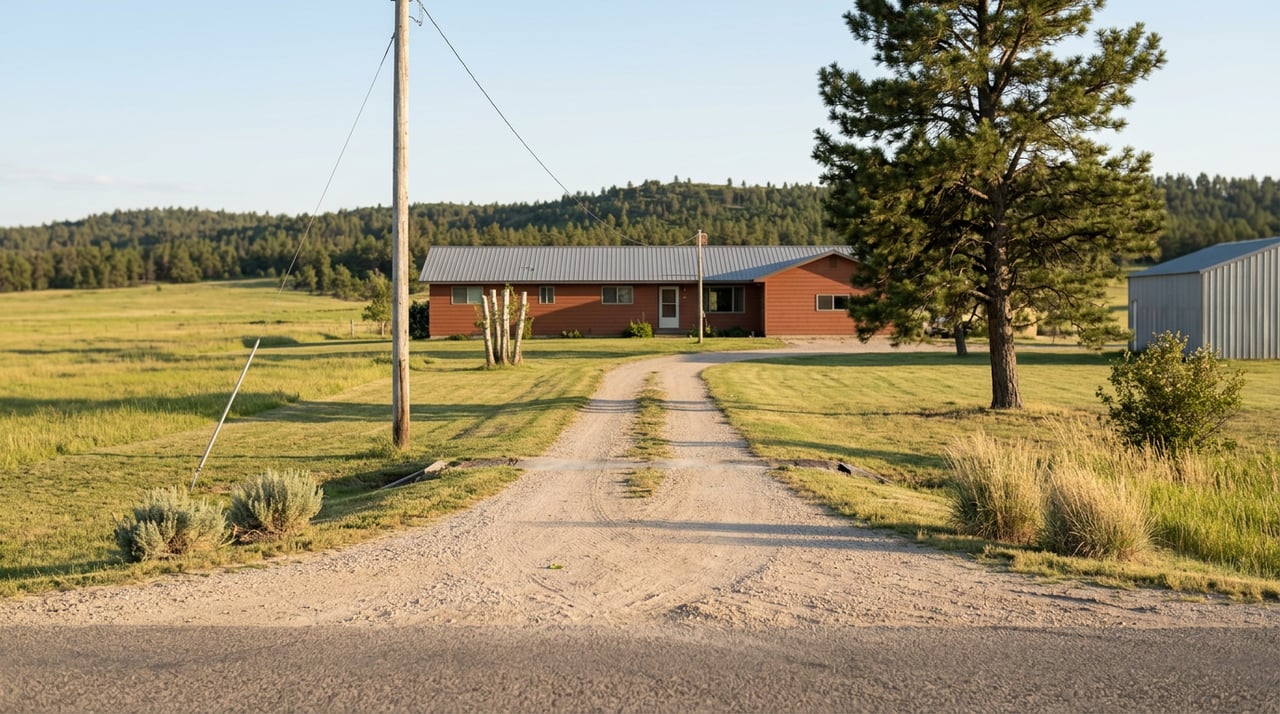
The Luther-Roscoe corridor sits between the county floor and Red Lodge proper. When you see a $25,000-per-acre parcel here and a $65,000-per-acre parcel three miles closer to town, most of the delta is not view or acreage. It is paved-road frontage versus gravel spur, transformer-at-corner versus transformer-a-half-mile-off, above-20 versus below-20, and whether an approved COSA or septic already exists. Two of those four are permits. One is a utility. Only one is scenery.
That reframing tends to change what buyers offer on. The best value on the corridor is often the odd-shaped 21-acre parcel with an old approach permit already cut, not the picture-perfect 15-acre lot with a listing photo taken at golden hour.
The Burnt Mountain wrinkle on the west side
One recent development matters for anyone weighing parcels on the west side of the corridor, closer to the Beartooth Front. On April 3, 2026, the U.S. Forest Service approved the Burnt Mountain Project, authorizing logging, burning, and road building on 1,386 acres of Custer Gallatin National Forest lands in the Nichols, Willow, and West Fork Rock Creek watersheds immediately west of Red Lodge. A 60-day Notice of Intent to Sue was filed on May 18, 2026 by the Alliance for the Wild Rockies and co-plaintiffs, challenging the project's handling of lynx and grizzly habitat. Carbon County News has the fullest local account.
For a buyer, this is not a reason to avoid the west side. It is a reason to ask specific questions about which watershed a parcel drains into, what the current unit boundaries look like, and how the timber sale schedule may affect access, viewshed, and recreation use during the first years of ownership. The answer may not change the offer, but it should change the diligence.
One small closing-cost note while you are budgeting: Montana HB192, effective October 1, 2025, raised Clerk & Recorder document recording fees to $20 for the first page and $10 per additional page, up from $8 per page. It is a modest change, but it is real on multi-page deeds, easements, and trust filings that are common on rural acreage.
FAQ
If a parcel already has a well and septic, how much of this still applies? Less, but not none. Confirm the well log is filed with DNRC, verify the water right or exempt-well status, request a copy of the septic permit and as-built from Carbon County Environmental Health, and ask when the tank was last pumped and inspected. Existing systems have a lifespan, and a system installed for a 2-bedroom cabin does not necessarily support a 4-bedroom build.
Is under-20-acre ever the right pick on this corridor? Yes, when the parcel already carries an approved DEQ COSA, when power is at the corner rather than down the road, and when the price reflects those advantages. The smaller parcel is not the problem. The unpermitted small parcel is.
Does gravel-versus-paved actually change resale? It changes who your buyer pool is. Paved access opens the corridor to second-home buyers and lenders who are skittish about winter access. Gravel keeps the pool closer to true Montana buyers. Neither is worse; they are different exit strategies, and pricing them the same at purchase is the mistake to avoid.
If you are weighing a specific parcel between Luther and Roscoe and want a second read on which side of these lines it falls on, Suzie Countway is happy to walk it with you before you write the offer. Let's Connect.